

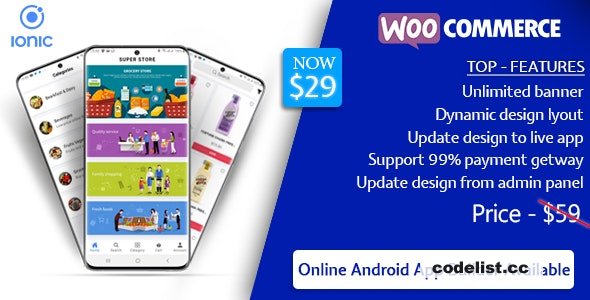
Manage home design from admin panel easily. create hundreds of layout with simple settings. Give your customer a unique feeling every day.
If you already operate or plan to launch a WooCommerce-based e-commerce business (especially a multivendor marketplace), then the app solution Quick Order (Ionic 5, Multivendor Features) is designed to bridge your website with a native-mobile experience on Android and iOS. This blog will explore what it is, why it matters, its core features, benefits and drawbacks, and how you might apply it in your region (West Bengal / India).
Quick Order is a mobile application template built with Ionic 5 (an Angular-based hybrid framework) that integrates with WooCommerce and adds marketplace / multivendor capabilities. In effect: you take your WooCommerce store (with multiple vendors selling products), and the Quick Order app gives you a ready mobile client for customers (and vendors) with native app feel.
It lets you avoid building separate mobile apps from scratch; rather you deploy a template that connects with your existing backend and vendor ecosystem.
Access the mobile-first audience: Many customers prefer mobile apps over mobile websites for shopping ease, notifications, smoother experience. Having a mobile app can increase engagement and conversions.
Leverage your existing infrastructure: If you already have WooCommerce with or planning multivendor plugin (for example with vendors selling on your platform), this template uses that backend — significantly reducing mobile-development effort.
Marketplace readiness: Unlike a single-store app, this supports multivendor workflows (vendors manage their products/orders) which is key if you plan a marketplace model or multiple storefronts.
Customization and control: You get source code (or at least a build-template) so you can tailor branding, layouts, themes, vendor flows, payment integrations to your regional needs.
Speed to market: Especially in places like Medinipur/West Bengal, if you want a mobile storefront quickly (for local vendors, local e-commerce), this could accelerate your launch.
Based on available description of the product, these are some of the important features:
Dynamic design layout: The home page, category blocks, product blocks, banner blocks are configurable via admin panel. You can create multiple layouts and update them live without redeploying full app. code.market+1
Multivendor support: The template supports vendor logins, vendor product management, vendor orders, vendor dashboard features. (Works with popular multivendor plugins of WooCommerce) WPSHOP+1
WooCommerce integration: Syncs products, categories, orders from your WooCommerce store into the mobile app. Supports popular add-on plugins like “Points & Rewards”, “Product Add-Ons”, wallet systems. code.market
Multiple theme support: Light / dark theme; many ready colour schemes (150+ prebuilt colours cited) so you can align with your brand identity. code.market
Push notifications: Customer notifications for order updates; vendor notifications for new orders or status changes. code.market+1
Social login support: Google login, Facebook login for easier onboarding of customers. code.market
Multi-language / localisation support: Supports WPML (for multilingual) so you can target regional languages (e.g., Bengali + English) if you customise. code.market
Online app build tool: Some versions advertise “online app builder tool” so non-technical persons can build Android app without coding. code.market
Reduced development cost and time: Instead of building two native apps (Android + iOS) from scratch plus the vendor management backend, this template bundles large parts of the mobile client logic.
Market-ready for marketplaces: If you plan multiple vendors selling through your app (a marketplace model), this gives that capability rather than a simple single-store.
Brand customisation: The dynamic layouts, theme colours, multiple ready designs let you tailor the app’s look and feel to match your business identity without starting blank.
Higher user engagement: Mobile app plus push notifications offers a level of engagement you don’t always get with mobile web alone. That can support retention and repeat purchases.
Scalable architecture: Because it is aligned with WooCommerce and vendor plugins, you can start small and expand (add more vendors, more product categories) without rebuilding your mobile client.
Performance may not match full native apps: Ionic is hybrid (web-wrapped) or partially native; for highly complex UI/UX or heavy animations, native apps may perform better.
Dependence on WooCommerce + Plugins: Since this is a template that hooks into WooCommerce and multivendor plugins, your backend must be robust, your WooCommerce version compatible, and your plugins supported.
Localization and regional payments may need customisation: For India (West Bengal, Medinipur), you’ll likely need to integrate Indian payment gateways (UPI, Paytm, Razorpay) and support local languages; the template may require modifications.
Support and updates: Templates often require you to handle updates, compatibility issues with new OS versions, and your customisation may complicate future upgrades.
Vendor management complexity: Running a multivendor marketplace adds operational overhead (vendor onboarding, quality control, payments to vendors, shipping/logistics) beyond just technical setup.
Since you are located in Medinipur, West Bengal, here are some contextual considerations and how you might apply Quick Order in your local market:
Local language support: Use the app’s multilingual capability to include Bengali and English in the UI. That way you can cater to local users who prefer Bengali as well as English-speaking users.
Payment methods: Make sure the mobile app supports local payment methods (e.g., UPI, Paytm, bank transfers) or you integrate them via WooCommerce plugins.
Local vendors & logistics: If you run a marketplace with local vendors (e.g., within West Bengal), you can target faster deliveries, local pickup, maybe same‐day delivery in your city. This gives a competitive edge over purely national chains.
Mobile-first user base: Many customers in smaller towns and cities use mobile devices primarily; having a mobile app improves convenience and may build loyalty.
Marketing your app: Promote the mobile app version of your marketplace among your vendors and customers; maybe provide incentives for first-time orders via the app, or vendor incentives to join your platform.
Start lean, expand later: Perhaps begin with a select set of vendors (e.g., niche product category) to test the marketplace model and mobile performance, then scale up once you gain traction.
Here’s a high-level checklist for how you might adopt Quick Order for your business:
Acquire the mobile app template and source code from the marketplace.
Confirm your WooCommerce store (or setup one) and ensure you have or plan a multivendor plugin (compatible with the template).
Configure the mobile app: customise branding (logo, colours), home page layout (using the dynamic blocks feature), theme (light/dark).
Integrate your payment gateway(s) and ensure mobile UI supports your local currency (INR) and local languages.
Set up vendor onboarding process: vendor registration, product upload, order management. Ensure your multivendor backend is well defined (commission structure, shipping rules, payout process).
Test thoroughly on devices typical for your market (lower-end Android phones, slower network) to ensure usability.
Launch the mobile app in Google Play Store (Android) initially; maybe later iOS if relevant. Promote the app among your target user base (in West Bengal and beyond).
Monitor analytics: user conversions, mobile app usage, vendor performance, order flow. Optimise layout, push notifications, vendor incentives based on data.
If you run or plan to launch a WooCommerce marketplace and want the mobile-app channel (not just mobile web), Quick Order offers a compelling, cost-effective path. It gives mature features (multivendor, dynamic layouts, push notifications) built on a well-known stack (WooCommerce + Ionic).
In your regional context in West Bengal, adopting a mobile app early for a marketplace can differentiate you from many local competitors who might still rely purely on websites or third-party apps. However, technology is only half the equation — success depends equally on vendor management, customer service, logistics, marketing, and local payment & language adaptation.