

This app isn’t an independent product. It only works with OGO : On-Demand Taxi Booking & Ride Booking App
The ride-hailing and taxi-dispatch market continues to grow around the world, and there’s increasing demand for turnkey solutions that let taxi‐companies, fleet-owners or local entrepreneurs launch their own “Uber-style” or “partner-driver” services. The OGO Driver/Partner App script is one such solution: built as a driver/partner side app that integrates with a larger on-demand taxi solution. Graphicfort+1
If you are considering launching a taxi-booking service in your city (for example Medinipur / West Bengal) or scaling up an existing fleet, a ready-source script like this can save development time. But software alone isn’t everything — ops, logistics, driver recruitment, regulatory compliance matter a lot.
Here are the key features as per the listing of the driver/partner app version: Graphicfort+1
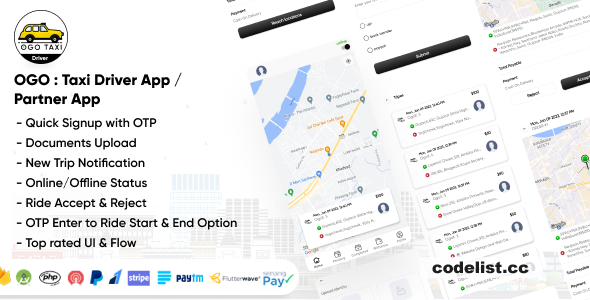
Driver/Partner App Features
Driver signup with OTP (mobile number verification) Graphicfort+1
Upload of required KYC documents (driver licence, vehicle registration etc) Graphicfort
View lists of trips: pending, running, completed Graphicfort+1
Track path to user pickup & drop-off (map integration) Graphicfort
Accept or reject ride requests Graphicfort
Ride start OTP confirmation (driver gets a new ride request, OTP to start) Graphicfort
Notifications for new orders, status updates Graphicfort
Driver can update profile, go online/offline (active/inactive) Graphicfort+1
Payout request/withdrawal feature for driver earnings Graphicfort
Important Note
The listing makes clear: this driver/partner app requires the full “customer app + admin panel + backend” solution to be in place. It is not a standalone full system. Graphicfort
If you already run a taxi fleet or are a local entrepreneur wanting to enter “on-demand taxi/ride sharing”, rather than build everything from scratch, this solution gives you a head‐start.
The driver‐app side is already built for Android (so cheaper than building Android + iOS). You can customise branding, region-specific logistics.
In smaller cities or towns (e.g., West Bengal, Medinipur region) where ride-hailing is catching up, having your own branded app can give you control (fees, driver payout, customer data) rather than relying totally on large aggregators.
The script supports KYC/document uploads, driver online/offline, trip lists etc — all foundational features needed for a fleet model.
Since this is just the driver app part, you will need to ensure you acquire (or build) the customer‐side app (rider app) and the admin panel/backend. Without those, you won’t have a complete product. The listing emphasises this. Graphicfort
Compatibility and support: Make sure the script is up-to-date, works with current Android versions, supports payment gateways & mapping in your region (India).
Localisation: You’ll likely need to customise language (Bengali, Hindi), currency (INR), payment gateways (Razorpay, Paytm etc) and possibly vehicle types relevant to your market (e-rickshaw, bike-taxis, etc).
Operational logistics: Software helps but key costs/risks remain — driver recruitment, vehicle management, regulatory compliance (taxi licences, permits), mapping and geo-tracking accuracy, insurance.
Earnings model & payouts: The driver app supports payout requests, but you’ll need a system for calculating driver commissions, fees, incentives, managing cancellations.
Customer side experience: Although driver app looks robust, your business success will also depend on how good the customer app is, how seamless booking is, how reliable your drivers are—software won’t guarantee those.
Marketing & competition: Large incumbents may already have presence; you’ll need differentiation (local service, pricing, reliability) and a plan to acquire users.
Maintenance & updates: Bugs, Android OS updates, API upgrades (Google maps etc) will require ongoing maintenance. Check what support the seller provides.
License & rights: Ensure you purchase legitimately from the marketplace and have rights to modify/brand the app as you need.
If you were writing this blog aimed at local taxi‐business owners or entrepreneurs in West Bengal, you might structure it like this:
Lead-in: “Why more local taxi fleets are turning to app-based dispatch systems”
Problem statement: Traditional taxi/fleet models face issues: manual bookings, inefficient dispatch, high idle time for drivers, poor tracking, limited customer visibility.
Solution: The “app era” – drivers get booking requests on mobile, customers book via app, you track everything. Introduce the OGO driver/partner app script as a core piece of that.
Features breakdown: Highlight key driver app features (OTP sign-up, KYC docs, trip lists, map tracking, accept/reject) and explain why each matters (e.g., KYC for safety/compliance, accept/reject for flexibility).
Business model: Show how you can use the app as part of your fleet business: driver onboarding, dispatch, earnings management, payout cycle. Tie into local pricing/driver pay norms.
Implementation roadmap: Step-by-step: buy the script → customise branding & region settings → test driver app & backend → launch with pilot drivers → launch customer side app → marketing & driver acquisition → monitor metrics (trips per driver, idle time, acceptance rate, cancellations) → iterate.
Cost vs ROI: Estimate small fleet scenario (say 20 vehicles), with driver/partner app in place, driver commission splits, average daily rides etc. Show how digitising can increase utilisation, lower idle time, raise driver earnings and company margin.
Local factors & tips: In West Bengal/India: integrate local payment methods (UPI, Paytm), ensure mapping works in semi-urban/rural regions (Medinipur might have weaker mobile/data coverage). Offer multilingual UI (Bengali + English). Be aware of local regulations for taxis.
Checklist & caution: (like above) – completeness of app ecosystem, driver management, maintenance, customer acquisition, differentiation.
Conclusion: For a fleet owner wanting to modernise and stay competitive, using a ready driver/partner app script like OGO gives a strong foundation — but success will depend on execution in operations, driver experience, customer satisfaction and ongoing marketing.
Title: “How Local Taxi Fleets Can Launch Their Own Driver-App with OGO: A Step-by-Step Guide”
Outline:
The digitisation wave in taxi & ride-hailing
Why your fleet needs a driver-mobile app (benefits)
Introducing OGO – what it locks in (driver side features)
How to integrate the driver app into your business operations
Customisation & localisation for your region (India, West Bengal)
Cost, expected returns & key metrics to monitor
Implementation roadmap (buy → customise → pilot → launch)
Potential pitfalls and how to avoid them
Tips for marketing & driver engagement
Conclusion: The way forward for taxi fleets in 2025-26
If you are looking to modernise your taxi or fleet business, especially in a smaller city or region where app-based services are growing but maybe not saturated, the OGO driver/partner app script could be a useful piece of the puzzle. It gives you a ready driver-mobile app with many of the required features built-in.
However — remember: software is only part of it. Driver quality, timely dispatch, customer service, vehicle condition, reliable mapping & network, marketing (getting users) are equally or more important. If you can align good operational execution with a proper app ecosystem, you can differentiate and build a strong local taxi brand.\
Demo: https://codecanyon.net/item/ogo-taxi-driver-app-partner-app/42925584