

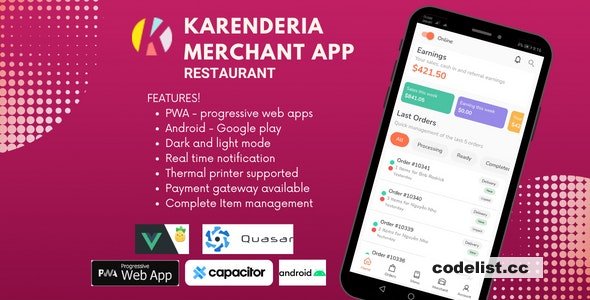
This is an addon for Karenderia Multiple Restaurant System, you need to purchase KMRS for this pwa and android app to work. Merchant app requires karenderia version 1.0.4
Karenderia Merchant App Restaurant is a dedicated mobile application (for merchants/restaurants) built to work alongside the broader Karenderia Multiple Restaurant System (KMRS) platform. According to the vendor description, its primary purpose is to give individual restaurants (merchants) real-time mobile access to the order-flow, status updates, push-notifications, and management of orders placed through the KMRS marketplace or system. code.market+2CodeCanyon+2
In simpler terms: if you run a restaurant and you’re using (or plan to use) the KMRS system for multi-restaurant ordering/delivery, this merchant app gives your restaurant staff a mobile (Android & iOS) interface to handle incoming orders, update statuses, accept/decline orders, and keep things moving without being stuck at a desktop dashboard.
If you’re considering a food-ordering business (for example a local multi-vendor food delivery market, or even a single restaurant aiming to scale) in Medinīpur / West Bengal, here are a few reasons why having a merchant-mobile-app makes sense:
Many restaurant staff prefer mobile access rather than being tethered to a desktop. Orders can be accepted/rejected or updated from smartphones.
Real-time mobile notifications mean you don’t risk missing or delaying orders because they were only visible on a web dashboard.
For a multi-restaurant system (where you manage many vendor restaurants), this gives each vendor a self-service tool, enabling decentralised operations.
Enables better responsiveness for the customer experience (faster confirmations, status updates) which helps build trust in your service.
If you intend to build a marketplace (many restaurants under one umbrella platform), having merchant apps adds professionalism and scalability.
Based on the publicly listed feature set, here are noteworthy features of the Karenderia Merchant App:
Real-time order receipt on mobile: Merchants get new orders pushed to their device. code.market+1
Push notifications for new orders (Android & iOS) so merchants are immediately alerted when an order is placed. code.market+1
Accept or decline orders: The app gives the merchant control to accept or reject incoming orders from the mobile device. code.market
Order-status updates: The merchant can change the status of the order (preparing, ready, delivered, etc) from the app. code.market
Order history and search: Merchants can view past orders, search by order id or customer name. code.market
Translation / multilingual ready: The app is built with support for translations, which is useful for supporting local languages (for example Bengali plus English) in a region like West Bengal. code.market+1
Menu/manage-on-the-go: While this is more implied by the merchant app use-case, the broader platform permits merchants to manage items, addons, sizes etc (via KMRS) so likely the app interfaces with that. GitHub+1
Integration with printer addon: Some update logs mention support for printing options from the mobile app. code.market
Empowers merchants to be mobile-first: Instead of being tied to a desktop, restaurants can operate via smartphones, which suits smaller towns or multi-branch setups.
Improves responsiveness: Faster confirmation of orders and status updates tend to improve customer satisfaction—critical in food-delivery space.
Supports scalability: If you plan multiple vendors/restaurants under your platform (or you’re one restaurant scaling up), having a dedicated merchant app means you can onboard more restaurants easily.
Enhances professionalism: A mobile app for your restaurant staff gives a more polished service impression to customers (they see you’re using modern tech).
Localisation friendly: With translation readiness, the app can suit region-specific language needs (for example Bengali interface).
Cost-effective: Rather than building a merchant-app from scratch, this template offers a ready solution which can save development time and cost.
Dependence on KMRS: The merchant app is an add-on to the broader Karenderia Multiple Restaurant System. You will need the core KMRS system operating (database, web dashboard, API modules) for the mobile app to work. code.market+1
Customisation may be needed: For the Indian market (for example West Bengal / Medinīpur), you will likely need customisation—payment gateway integration (UPI, local wallets), local tax/restaurant regulatory compliance, support for local delivery workflows.
Performance & device diversity: In smaller towns, many devices may be low-spec or network connectivity patchy, so you should test the mobile merchant app under those conditions.
Ongoing maintenance & updates: As OS versions update (Android, iOS), you’ll need to ensure the app remains compatible; the template may require updates/new features which might come at additional effort.
Operational overhead: Having a merchant app is only part of the setup—your actual operations (logistics, food preparation, delivery, vendor management) still need strong processes; technology is enabling, not sufficient alone.
Here are some region-specific considerations for implementing this in your locale:
Language/localisation: You can configure the app to support Bengali plus English. This gives you competitive advantage in local markets where many users prefer Bengali interfaces.
Payments: Integrate local payment methods such as UPI (Google Pay, PhonePe), Paytm, Net-Banking, COD (cash on delivery). The template likely supports generic gateways; you’ll need to ensure local gateway plugins are supported or custom-integrated.
Connectivity / device types: In Medinīpur and nearby areas, internet connectivity may vary; ensure your merchant app and backend are optimized for low-bandwidth, and test on common local mobile devices.
Delivery ecosystem: If you are managing many restaurants, you will need delivery logistics. The merchant app handles orders; you may need integration with driver apps (if you operate delivery), or partner logistics.
Small restaurant adoption: Many small restaurants may not yet have smartphone-based operations. Part of your rollout may involve training vendors/staff to use the merchant app.
Market differentiation: Having this merchant app and mobile ordering system can differentiate you against local competitors who may rely only on phone calls or simple websites. This gives you a modern edge in your region.
If you decide to adopt the Karenderia Merchant App Restaurant for your business, here’s a rough roadmap tailored for a regional rollout:
Acquire the merchant app package (template) and ensure you also have the KMRS backend or plan to set it up.
Set up the KMRS system: database, web dashboard, restaurant vendor onboarding, product/item management, menu categories, addons.
Configure the merchant mobile app: branding (logo, colours), translation/language settings (Bengali/English), merchant accounts for your restaurants.
Install and configure merchant mobile app for each restaurant: provide merchant staff with login credentials, show them how to accept orders, update statuses, use push notifications.
Integrate local payment gateways and delivery workflows: within KMRS, ensure payment options reflect Indian market (UPI, Paytm, COD), and that the merchant app can handle relevant status updates (order placed, accepted, prepared, dispatched).
Test thoroughly: run end-to-end flows from customer order to merchant app notification to preparation to delivery/capture. Test under local network/device conditions.
Launch restaurants in waves: perhaps begin with a few pilot restaurants in Medinīpur, train their staff, refine processes, then scale to more restaurants and expand regionally.
Monitor metrics: merchant app usage, order volume per restaurant, order acceptance rate, delivery times, customer satisfaction. Use this feedback to optimise app workflows and operations.
If your business model involves multiple restaurants, online ordering, and you want to empower your vendor restaurants via mobile tools, the Karenderia Merchant App Restaurant offers a strong starting point. It gives a ready mobile interface to the restaurant side of operations, which often gets less attention than the customer-app side.
In your context in West Bengal (Medinīpur) this can be a strategic advantage: you can onboard local restaurants, give them modern mobile tools, and build a regional ordering/delivery platform that looks polished and professional.
Of course, technologies are enablers—not magic. The real differentiators will be your vendor relationships, reliability of order execution, customer experience, delivery logistics, and local adaptation (language, payment, device performance).
Demo: https://codecanyon.net/item/karenderia-merchant-app-restaurant/42215908